Six Places, One Bus, Eleven Hours: Yerevan to Goris Through Armenia’s South
Garo Kotchounian9 min readFiled under Տ, dyoun, in the alphabet indexTatev to Goris
In this article (7)
For the eleven hours and more that the trip lasted, Karina gave us two things at once: the history of every village the bus passed, and, between the villages, her voice. A linguist by training, a singer by first profession and a guide by choice, she never once made us choose between the mind and the music.
That is the whole shape of this day, and it took me until the evening to understand it.
The bus
At ten in the morning, waiting at Sasuntsi David station for my tour bus, I am standing in front of the statue of David of Sasun on his horse, Gourgik Jalali (Kurkik Jalali, as it is usually written in English). The statue is Yervand Kochar’s, raised in 1959 and now so much a part of the square that people give directions by it; it is the first thing you see coming out of the railway station and the last thing you see leaving. The plan was a day trip south: the long road down through Vayots Dzor to Tatev monastery, and then Goris, where Tatev Asatryan was giving a concert that night in the park. I had booked it the day before. After Yerevan, I was done with not booking things.

The guide was a woman called Karina, and she stood at the front of the minibus with a microphone and did not sit down for the next four hours.
I want to be precise about what that means, because “tour guide” undersells it. She did not recite. She pointed out of the window at a village in a hollow and told us its old name was Chanakhchi, from the Turkish for bowl, and that it had been renamed Zangakatun after the poet Paruyr Sevak died, for his poem The Unsilenceable Belfry. She told us Artashat was founded in 189 BC by Artashes the First and that Hannibal, that Hannibal, had ended his days there and designed the city. (Plutarch does have Hannibal, in exile at Artashes’ court, laying out the plan of the new capital; where he died is a longer argument, and not one for a bus.) She pointed at a hill and said it was the sixth of the nine hills of old Artashat, that six was an unlucky number, and that under it was the pit where Gregory the Illuminator spent thirteen and a half years with the snakes and the scorpions while a widow brought him bread. That is Khor Virap: the pit is six metres deep, and the church that stands over it now dates from 1662. “His name was Narek, by the way. Not Gregory.”

Then she told us the town of Ararat has a cement works, a gold refinery, and a football pitch that Casillas came to open. “You know him. I’m one of you.”

Who she is
Somewhere past the Ararat plain she stopped and introduced herself properly, which she said was shameful not to have done sooner. She has been a guide for nine years, and she is a French linguist by training, with French, English and Armenian. And then she said:
“By my first profession, I’m a singer. I was Arthur Grigorich’s student for ten years. After his death, I simply stopped singing. But on tours, I sing. So today, you’re my audience.”
Arthur Grigorich, named the Russian way after his father, is the composer Artur Grigoryan (Yerevan, 1958 to 2022): founder of the State Song Theatre of Armenia in 1994, teacher of a generation of the country’s pop singers, and creator of the Voices of Artsakh children’s ensemble. He died in February 2022 after a long illness. Karina was his student for ten years.
She had us go round the bus and say who we were. I said my name was Garo and I had come from Cyprus to be with them, which got a laugh. There were people from Belgium, a driver, an accountant who had never been to Tatev and was, she said, very upset about it.
Then Karina asked if anyone knew Bingyol, and sang it: the song to Avetik Isahakyan’s words, the one every Armenian knows at least the first line of. She stood in the aisle, one hand on the seat-back, eyes closed for the long notes. The bus went quiet in the way a room goes quiet when somebody is actually good. When she finished there was applause, and she said thank you as if it was nothing and went back to the microphone.


Vayots Dzor
She named the villages as they went by: Yelpin, Gnishik, Hrind, Chiva, Amaghu, Khachik, Areni. She pointed out a rock shaped like a dragon, and explained that the town of Vayk got its name when survivors of an earthquake in the old district of Moz were asked where they had come from and answered chik vayr: there is no place.
At Areni she told us about the cave. There was a shoe, a woman’s, size thirty-seven, which she put at six or seven thousand years old and which is in any case the oldest leather shoe anyone has ever found. The archaeologists’ dates for the cave run from 4300 to 3500 BC, and the shoe itself is in the History Museum in Yerevan. There were grape pips. There were the skulls of three teenage girls, which is how we know it was a place of ritual. And there were the wine cellars, which is how we know it was also a place of wine, and the oldest one known.
“Our difference from the Georgians,” she said, “is that we don’t bury the karas all the way. A third of it stays out of the ground. They put theirs right down in the pit. So their wine comes out a little more rotten, and ours a little more watery.” She let that sit for a second. “Imagine.”
Then Noravank went by in its red rocks and she explained why every Armenian monastery is somewhere you cannot easily get to: so the clergy could cut themselves off and study, because a monastery was never just a church. “A university, a school, a library, a refectory, a distillery. A church is one building. A monastery is the whole thing.”

Hell’s gorge
The road drops into the gorge of the Arpa, and the rock turns red. “Red stands for hell,” she said. “They call it Hell’s Gorge.” Somewhere above it is a platform where they drop you a hundred and twenty metres on a rope. She has done it eleven times in nineteen years. “Forty thousand dram. But that money is nothing, in that moment, for what you feel.”
We stopped at Shaki waterfall: eighteen metres of water over a basalt ledge in the Vorotan gorge, a few kilometres north of Sisian. It pours over a wide lip of rock into a green bowl, and there is a kiosk at the bottom with a hand-painted sign reading beer coffee wine jan gata. I said to the camera that we had reached a wonderful place, and then said it again, because I could not think of anything better and it was true.


Tatev
We reached Tatev at six in the evening, with the light already going soft.
It is a ninth-century monastery on the edge of a gorge (the church of Saints Paul and Peter went up between 895 and 906), and it is one of those places that is more than its photographs, which is rare. For forty years in the late Middle Ages it was also a university, one of the great ones of the Armenian world, and the man who made it so is buried here. Karina took us through it the way she had taken us through the day: standing in front of a wall of small carved crosses and explaining that each one is a donation, that a family came and carved one cross for every member of the household, and the bigger the cross the bigger the gift, and in return their names were read out at the liturgy.


She stopped us on the path into the church, which runs over the graves of the people who built it. “Our church does not accept a grave inside a church. Why? Because where love is born, there should be no death.” So they are outside, under the path. “It was their last wish, that you walk over them. To show they still serve the church. And that you, by walking, absolve them.”
In the courtyard stands the Gavazan, the staff: an octagonal column raised in 904 and topped with a khachkar, built so that it rocks on its base and settles again, an early warning of earthquakes, the story goes, or of an army on the road. It has been standing and swaying for eleven hundred years.

She showed us the yerdik, the smoke-hole in the roof. She showed us a hatch in the floor that leads to a tunnel that leads to the gorge, and told us not to try it. “I will not take you back to Yerevan. You’ll stay here.” She showed us the room where Grigor Tatevatsi is buried, the philosopher and teacher under whom the University of Tatev had its great years, from 1390 to 1434, and said that when we got to Goris we would be going to the square that carries his name, which turned out to be exactly where the concert was.

And then, on a stone balcony at the edge of the monastery with the whole gorge dropping away below it, with half the group filming on their phones, she sang again.
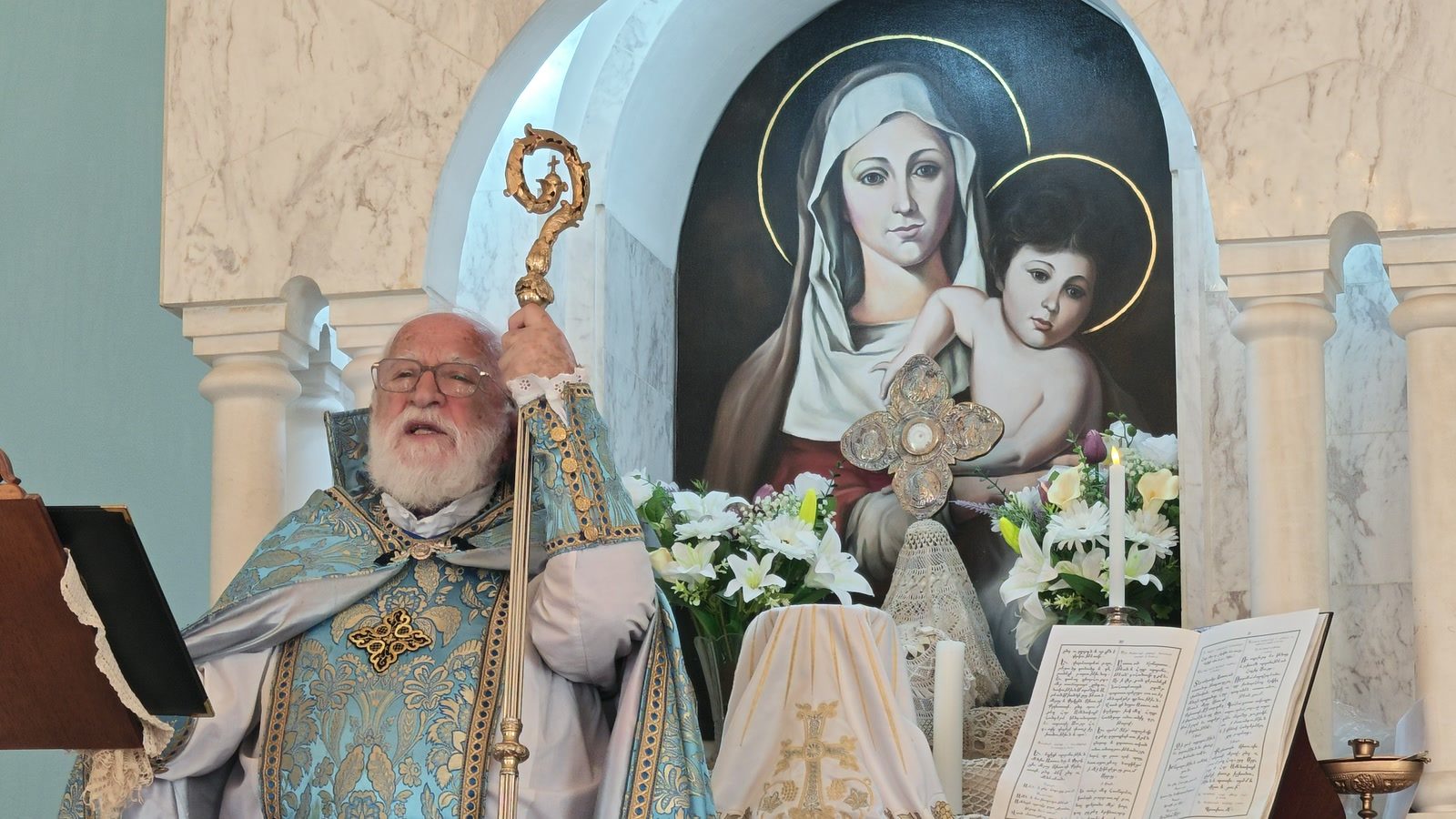
The song was Ayayi Yerkir Artsakh, a single by Gaya Arzumanyan. I know that at the end of it a woman behind me said bravo quietly, twice, and that a few minutes later the bells went and an evening liturgy began in the church behind us, led by Archimandrite Father Mikael Gevorgian in blue and gold at the lectern, a congregation of women in headscarves before him, candles floating in a basin of water, and that it felt like one thing had led to the other.


Goris
We got into Goris after dark, in rain, and walked into Memorial Park where the stage was.
Tatev Asatryan is a serious pop star and it was a serious show: an LED wall the size of a building, a camera on a crane, pyrotechnics, a crowd that filled the square. I will not describe the songs, because I cannot use them and this is not a review. What I can describe is the moment before one of them.

She stopped the band and asked the grown-ups in the crowd to applaud, loudly. And then she told us that the song she was about to sing, she had first sung at ten years old, for her mother.
“My mother loved folk songs, and this one especially. At home she would always sit me down on the floor, on the rug, the khali, as we say. She’d take a chair and sit in front of me, and I’d be there on the ground. And she’d say: Go on, sing. I am your hall. I am your audience.
After my mother, that hall filled up with you. And you became my audience, the ones I’ll sing for my whole life. Thank you. And tonight I want to sing this song the way I sang it when I was small. Sitting on the ground. If you’ll allow me.”
And she sat down on the stage floor.

What I understood on the way home
I had spent the day with a woman who had been a famous singer’s student for ten years, stopped singing when he died, and now sings only for strangers on buses. And the day ended with a famous singer sitting on a stage floor to sing the way she had sung for her mother.
I do not think Karina and Tatev Asatryan have ever met. But they were doing the same thing, and I think for the same reason, and it has something to do with who is listening.
The bus, the road and Tatev were a Unique Land day tour: uniquelandarmenia.com, @uniquelandtour. Karina is their guide. Ask for her.
Next: a dog, a cave town and a swinging bridge, from Goris to Kapan.