Kapan to Gyumri in One Day, by Shared Taxi, Metro and the Train Along the Turkish Border
Garo Kotchounian7 min readKapan to Gyumri
In this article (7)
At five in the morning, in my hotel room in Kapan, I told the camera why I was going to Gyumri by train. “Because it runs right along the border, the border with Turkey, where a river splits us, divides us,” I said. “From there the train passes very close: on one side is Armenia, on the other side is Turkey.” The plan for the day was a shared car to Yerevan, a few hours in the city and then the afternoon train north, which made twelve hours of travel from one end of Armenia to the other.
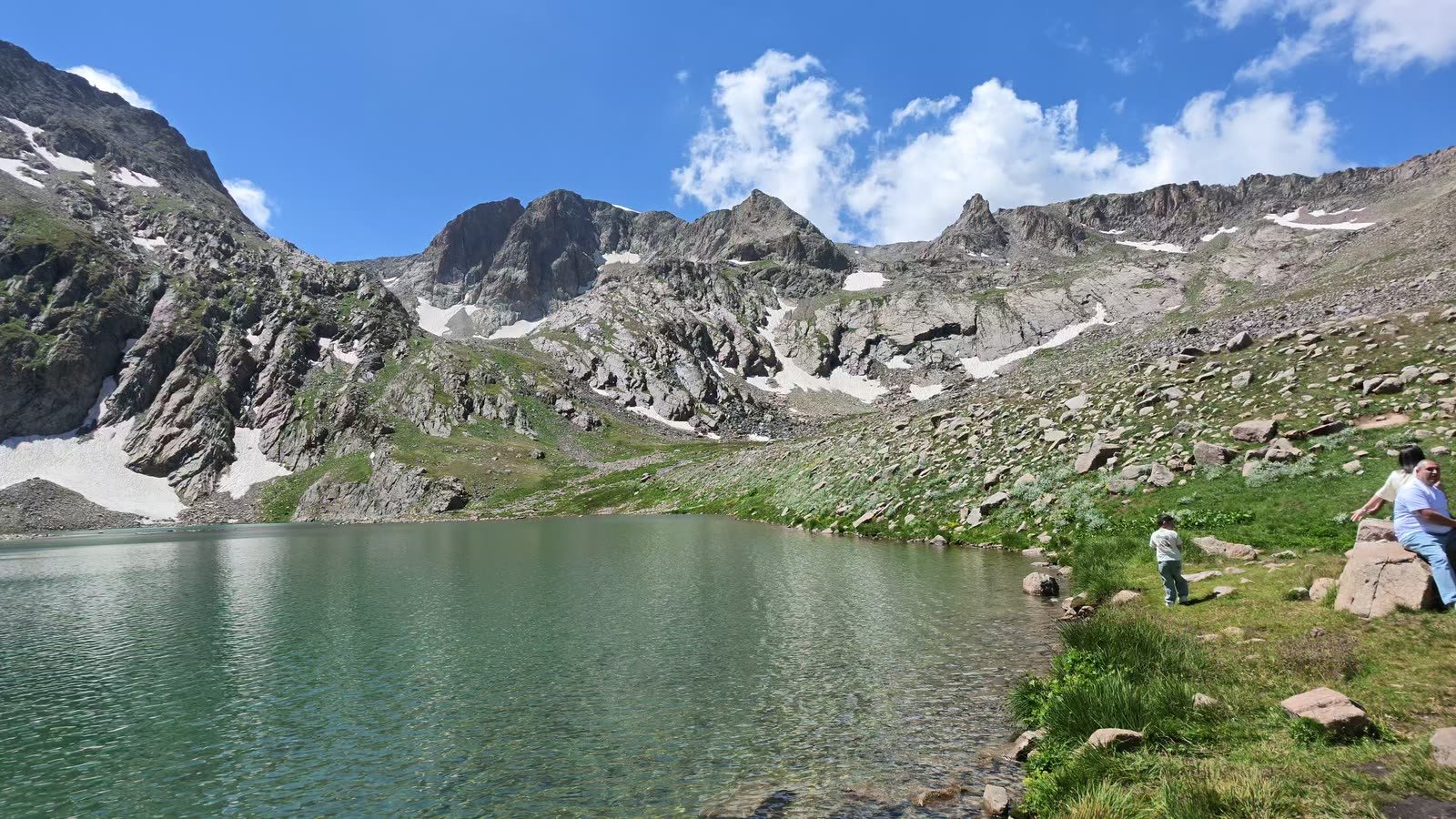
It was Wednesday, the nineteenth of August, the day after the lake at 3,270 metres and Meghri on the Araks, and the day on which this trip came back to the city where it had begun.
Five in the morning in Kapan
I went down at five to check out of Hotel Syunik, where I had stayed for three nights. It was very good: a quiet, lovely and peaceful place, and clean. It is a boutique hotel, and I had a really nice experience there. Outside stood the hotel’s bicycles, which are free for the guests. At night they are covered so that they do not get damp, and in the morning the staff uncover them again so that guests can ride around the town.

The car was due at half past five, and it was the only one of the day. An office in Kapan that I had spoken to arranges it through taxis. There is also a bus from Kapan to Yerevan, for 20,000 dram, but I wanted to enjoy the road, with things to film and new things to see, and in general I prefer a car to a bus. A taxi of my own would have cost four, five or six times as much. Leaving at that hour meant that I could spend a few hours in Yerevan before the train, and I told the camera that we would see what news and what surprises the day put in front of us.

Over the mountains
The car did not go through Goris. It took the road over the mountain past Tatev, the same road that had brought me down to Kapan three days earlier in the rain, and this time the morning was clear. That road became the way round in November 2021, when Azerbaijan set up checkpoints on a stretch of the old highway between Goris and Kapan that runs through land it has held since 2020.
At two minutes past seven we passed Tatev monastery, standing in the low sun beside the road. A few minutes later the road dropped into the gorge of the Vorotan and passed within about a hundred and fifty metres of the Devil’s Bridge, the natural rock bridge over the river below Tatev. On the far side it climbed out again, past villages built on shelves above the gorge, and through Shinuhayr it joined the main highway near Sisian.


Near the Spandaryan reservoir my phone read 2,116 metres, and soon afterwards the highway crossed the Vorotan pass, which at 2,344 metres was the highest point of the day. A little before nine we stopped at a food court in Vayk, a town that lies at about 1,300 metres on the Arpa river. It marked the halfway point between Kapan and Yerevan, and breakfast was a bottle of Kilikia fruit soda and a pastry.

Beyond Vayk the road runs down through Vayots Dzor, where golden, sunburnt mountains rise above green villages. I photographed them near Areni, whose cave gave archaeologists the oldest known winery and the oldest known leather shoe. Then, on the Ararat plain, Mount Ararat, at 5,137 metres, showed both of its peaks, faint in the haze.

Charbakh, and the metro entrance I could not find
I reached Yerevan at about eleven, into congestion and heavy traffic. The car left me in Charbakh, “or whatever it’s called”, as I said to the camera before I got the name right. It is an area of factories with a metro station somewhere among them. My plan was to ride the metro to Sasuntsi David, the stop for the railway station, leave my backpack there and walk around a little before the train left at twenty-five past two, which gave me about two and a half hours.
The Charbakh line, I explained, is the only one in the system that goes to just one place, where you have to get off and change, and I could not remember which station that was. I promised to look it up, and I did. Charbakh runs a single stop, to Shengavit, where you change for the main line. It opened in 1996 and is the only station of the Yerevan metro built since independence.
Then I gave you another piece of information. “Inside the metro, filming is forbidden by law,” I said. “So before this, I was filming and the police came and spoke to me. I don’t have any of that footage, because I deleted it in front of him.”
Since my earlier visits the metro has changed, and for the better. Before, you had to buy a ticket and change tickets. Since January 2025 the metro has taken no cash at all: you tap a bank card at the gate, and since 21 July 2026 you can also pay with Google Pay or Apple Pay on a phone or a smartwatch. For those of us who do not live here, I said, they have made the easiest system of all, which is tap to pay. A ride costs 150 dram, the same as a local bus, and in this city the metro takes you everywhere and back more easily than a car stuck in traffic.
First, however, I had to find the entrance. I asked the way, and I was pointed a little further on and then to the right, but the factories are big, and they confuse you. A helicopter flew low overhead while I searched. When I finally stood at the door, I told the camera what had happened: “We’d gone the wrong way. I asked the lad where it was. ‘Further on,’ he said, and off we went. Halfway, it turned out he was going there himself; he didn’t know either, and the two of us went the wrong way. And me, following him.”

The 14:25 to Gyumri
Yerevan’s railway station, beside the Sasuntsi David metro stop, was completed in 1956, but the railway itself had reached the city in 1902. The regular electric train to Gyumri leaves every day at 14:25 and arrives at about half past five, taking a little over three hours to cover about 155 kilometres. A faster train runs only from Friday to Sunday, and this was a Wednesday.

The line runs south to Masis and then west across the Ararat plain. Behind the town of Metsamor stand the cooling towers of the Armenian Nuclear Power Plant, the only nuclear power plant in the South Caucasus, which was shut down after the earthquake of 1988 and restarted in 1995. After Armavir the train turns north-west across the steppe, and just after Aragats station I filmed a man forking hay beside the line.

At ten to five we passed Bagravan, a border village. About nine kilometres to the west of it, across the river, lie the ruins of Ani, the old Armenian capital, but nothing in my pictures shows them.
Along the Akhurian and the border
A few minutes after five the water appeared. This is the Akhurian reservoir, formed by a dam on the Akhurian river that was built between 1975 and 1980. For about eight kilometres the rails run less than a kilometre from the water, and the border runs through the water itself, about a kilometre from the train. As I say in the film: “Here are the waters of the Akhurian, the river. The border runs through the water. The far shore is Turkey. You can see it, but you can’t go there, because there are no relations between the two states.” The border between Armenia and Turkey has been closed since April 1993.

Back in Gyumri
At half past five we pulled into Gyumri, after twelve long hours of travel from Kapan. This trip had begun here ten days earlier, when I flew straight into Gyumri. The railway here once went on to Kars, in Turkey, but that line has been closed since the last train crossed the border in July 1993.

Have you ever taken this train? Tell me in the comments under the film, yes or no.
If you make the same journey
The whole journey is about 300 kilometres by road and about 155 by rail, some 450 kilometres in all, and it took me just under twelve hours. The shared car leaves Kapan at half past five in the morning, and I booked my seat through an office in Kapan that arranges it through taxis. In Yerevan, the metro from Charbakh runs one stop to Shengavit, where you change for the main line and ride two stops north to Sasuntsi David, the stop for the railway station. A ride costs 150 dram and is paid by bank card, phone or watch, because no cash is accepted. The regular electric train to Gyumri leaves every day at 14:25 and arrives at about half past five, and because the faster train runs only from Friday to Sunday, it is worth checking the timetable at the ticket office in Yerevan station before you plan around it. In Kapan I stayed at Hotel Syunik, which cost me 15,000 dram a night, or about 35 euros.
In the next article, I stay in Gyumri.