Goris to Kapan in One Day: Old Goris and the Swinging Bridge over Khndzoresk’s Cave Town
Garo Kotchounian13 min readFiled under Գ, kim, in the alphabet indexGoris to Kapan
In this article (8)
Nobody planned this day. I woke up in Goris with no idea where I was going, and by the evening a dog had guided me through the old town, I had walked what I was told were 480 steps down into an abandoned cave town, a hotel owner’s son had driven me over the mountain to Kapan, and the weather had cancelled my plan for the next morning. I loved it.
It was Sunday, the sixteenth of August, the morning after Tatev Asatryan’s concert in Goris, and for once I let the people I met decide where the day would go.
Half past nine, Hotel Mira
I had arrived at eleven or twelve the night before at a small hotel called Mira, which I had booked online, and they gave me a studio-like room. In the morning I stood in the corridor and told the camera the truth: I would go down, have breakfast, pull myself together and only then see where to go first.
The view from the hotel took me straight back to Lebanon, where I grew up. As I said to the camera, “Anyone who knows Lebanon, its villages, its towns, its mountains, will relate; they’ll understand what I’m talking about with this view.”

The first thing I want to tell you about that hotel is not really about the hotel. I had booked it on booking.com with breakfast included, and a message arrived in Armenian: “Where did you get this price? We don’t have such prices.” It worked out in the end, but I told the camera what I had learned from it: “Don’t trust Booking in Armenia.” So here is my first piece of advice from this trip. If you are going somewhere in Armenia and you have booked it on Booking or Airbnb, contact the place a few days before you arrive, or at least have their number. Call them or write to them on WhatsApp, and confirm before you turn up.
Breakfast was on a red kilim under the trees, in a garden full of roses, and whatever the message had said, I was already forgiving them.

Elmira
That morning I asked the owner her name, and she told me it was Elmira. The hotel, she said, is named after her granddaughter, who was named after her in a shortened form, “because Elmira isn’t in fashion, but Mira is.”
Then she said, “And there’s another surprise for you,” and switched to Greek.
She speaks Greek very well, she explained, because she and her husband worked for ten years in Athens. They came back and ran a hotel here together. Her husband has since died, and now her son works with her. “And I was very happy to have a visitor here from Cyprus,” she said, in the language of the country where I live. When I thanked her, she answered in Greek once more: “Thank you for being here.”

I did not expect to hear Greek in a hotel in Goris. It was my first time in the town, and I told the camera: “It’s not only Yerevan you should see. Goris is very beautiful too.” If you have Greek-speaking friends who want to see Armenia beyond Yerevan, send them to Hotel Mira in Goris and tell them to ask for Elmira.
The town
They told me to go and see Old Goris. On the way I stopped a woman in the street and asked where I could catch a bus to Kapan. “Over there, at the crossroads, there’s a minibus at the crossroads,” she said, and then, to be sure I had understood: “Half past two is the last one.” I filed that away.

Then I walked into Memorial Park, where the concert had been the night before. The stage was still standing, and an army of people in orange vests was cleaning up after the crowd that had filled the park.
Goris has its own Eiffel Tower, a tall replica standing in the park. An illuminated Eiffel Tower first went up in the centre of Goris among the town’s New Year decorations at the end of 2019, and people here joked at the time, turning round the old proverb about Muhammad and the mountain, that the Eiffel Tower had now come to Goris.

Further on there is a white stone monument, and I had to walk right up to it to read the name: Gusan Ashot. I asked the camera what kind of gusan he had been, and I could not answer my own question. I can now. Gusan Ashot was the stage name of Ashot Dadalyan, a bard who was born here in Goris in 1907. In 1928 he came back from Baku to Zangezur, the historical region around Goris, and worked there as a gusan, and in 1948 he settled in Yerevan, where he led his own ensemble and gave concerts in Armenia and abroad. His instrument was the kamancha, and Armenian sources count some 600 songs and about 5,200 poems of his that survive. Avetik Isahakyan heard him sing in 1938 and was deeply moved. He was made a People’s Artist of the Armenian SSR in 1967 and died in Yerevan in 1989. The monument I was standing at is the work of the sculptor Getik Baghdasaryan, installed in 2005 in the centre of Goris, opposite the culture palace named after him. The poet is carved from the waist up, and the detail that had caught my eye, a hand resting on a sphere beside his name, is his own.

I told the camera that I am no good at poetry and have never studied it. I am good with technology and computers, I said, and if it is language you are after, I will make mistakes, so keep me straight. And then, standing there, I said something I had not planned to say, about why I am doing any of this.
What I’m trying to do is introduce our Armenianness to us. First I get to know it myself, so that I can pass it on to our young people, to my son and my daughter, first of all. … It’s important to know where we came from, what we came with, what we had, but not only that. … You can’t build anything on the past alone. Everything ends. So we can’t be satisfied with only what we had. By preserving alone we can’t go forward. We have to create too, do something, each one with what he draws, what he writes. … Whatever a person is good at, with that, if he can help his brother, his relative, his acquaintance, his fellow Armenian…
That is the whole reason for these films and articles. I spoke for a little more than a minute, in front of a monument to a man whose name I had only just read.

On my way to Old Goris I passed the church of St Gregory the Illuminator. It was Sunday, and not an ordinary one: it was the Feast of the Assumption of the Holy Mother of God, which the Armenian Church keeps on the Sunday nearest the fifteenth of August, and after the liturgy on that day the priest blesses the first grapes of the year and hands them out to the congregation. The church was full, with women in white lace veils, a priest at the altar and a table of candles. I went in, crossed myself, lit a candle and came out into the kind of morning air you cannot explain to someone who was not there.
The church has had a long road of its own. It was begun in 1897 by the Melik-Huseinians, the noble family of Goris, with money raised across the whole town, and Khrimyan Hayrik, then Catholicos Mkrtich I, consecrated it in 1903, before it had a dome or an altar. It closed in 1926, served as a grain store and then as a local history museum until 1988, and reopened as a church in December 1989. Its dome and sanctuary were completed in 1997 to a design by the architect Sevada Zakaryan, and today it is the cathedral of the Diocese of Syunik.

Old Goris, and the dog
Old Goris sits at the edge of the town under pinnacles of soft volcanic rock, worn by wind and rain into something like a stone forest, with caves in them where people once lived. They are known as the stone pyramids of Old Kores, as the old settlement was called. The town I had slept in was built beside it and completed in 1876, to a plan by a German architect.
I went in alone and came out with a guide. A pale, shaggy dog with dark ears attached itself to me at the first rocks and walked ahead, looking back to check that I was following. “Doggy, are you alright?” I asked it. “It’s showing me the way. This dog is today’s tour guide, it seems.”

It walked me down and walked me back up, and when I reached the road it wanted to play with my gear. I told it, “Doggy, I love you,” which was true.

Standing among those rocks, I also told the camera how the day was going to work. I wanted to reach Khndzoresk and then cross to Kapan, and I had booked nothing. “We’ll find a hotel, or a place to stay,” I said. “Armenians won’t leave us in the middle of nowhere: if we don’t find one, we’ll stay in someone’s home. It’s nice: you have to take the risk, without making a plan.” That, after all, is how this whole trip began: I had asked an AI to suggest places in this part of Armenia that I had never seen and would want to visit.
Khndzoresk
Spartak, Elmira’s son, drove me. The hotel is a family business, and he became the day’s driver, first to Khndzoresk and in the end all the way to Kapan.
Old Khndzoresk is a gorge with a town carved into it. At the start of the twentieth century it was the largest village in eastern Armenia, with about 8,300 people in some 1,800 homes, many of them caves. In 1958 its people moved up to the new village on the rim. Accounts differ on why: some point to an earthquake in the 1930s, others to Soviet officials who judged life in the caves uncivilised. Across the gorge now hangs a swinging bridge, opened in June 2012. It is 160 metres long, it weighs 14 tonnes, and it can hold about 700 people at once.
From the top, the first thing I said was, “Look at those ants, people, I mean.” Then the scale of it sank in: “Look what a wonderful place: every mountain is honeycombed; people lived in there.”

I had been told there were 480 steps from the top of the stairs down to the very bottom. I decided not to count them on the way down and to take the number on trust. On the way down a man greeted me, asked whether I was tired, and said: “Going down is easy. Let’s see how you come back up.”

The bridge sways, and you can see it in the film. On the far side stands the ruined church of Anapat, a seventeenth-century hermitage, with gravestones carved with horsemen and inscriptions, and a sign for the grave of Mkhitar Sparapet. Mkhitar was an eighteenth-century commander, the chief aide and then the successor of David Bek, and from 1728 he used the fortress of Khndzoresk as his base. In 1730 villagers here, afraid of Ottoman reprisals, murdered him and took his head to the Ottoman pasha at Tabriz, who had the killers beheaded. He is buried at Anapat, and the tombstone traditionally identified as his is carved along one side with a procession of round-faced horsemen, one of them holding a long lance. Restorers cleaned the old lichen from the gravestones beside the church in 2025.

Then my camera battery died, which is why the film has no footage of the climb back up.
Dead stones
Above Goris, on the way back, Spartak stopped at the town’s old wall and picked up a rock the size of a loaf. “These stones are called dead stones,” he said, and handed it to me. They are brownish and reddish, and so light that, as he put it, “This big one, you can hold it with two fingers.” All I could say was, “Seriously? Like earth.” Below us the whole town sat in its bowl of mountains.
The name is a local one for porous volcanic stone, and Syunik is volcanic country, with at least 160 volcanic centres across its upland. The monument to the Old Bells of Goris is built of the same kind of stone, brought from Mount Ishkhanasar, and people here call that dead stone too.


The road, and Kapan
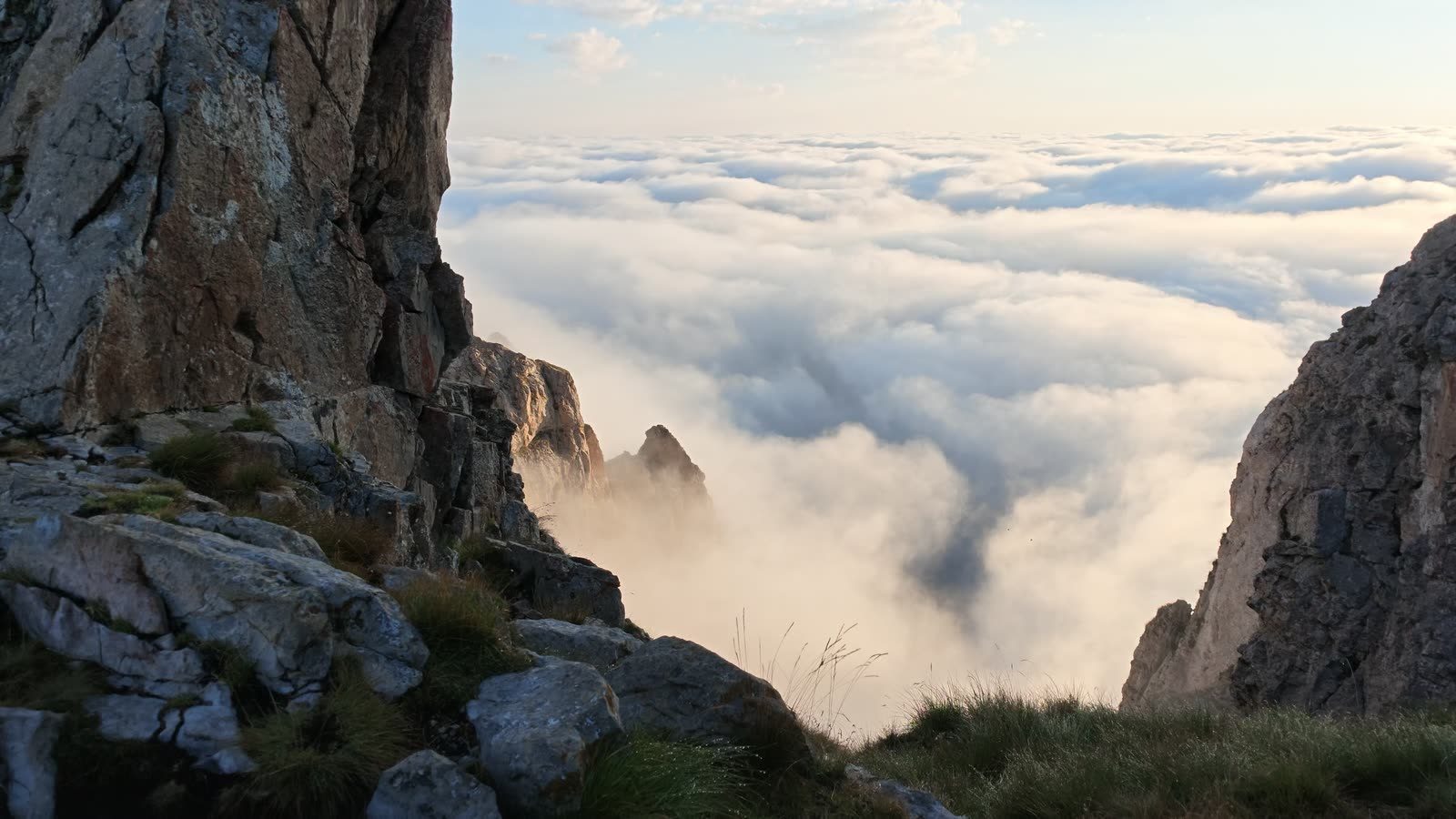
The direct road from Goris to Kapan is closed these days, so traffic goes the long way round, over the mountain past Tatev. We watched the cable-car wires disappear into fog, and then the rain came down on the windscreen as we passed the monastery I had walked through the day before. I had told the camera we would be in Kapan in an hour and a half or two hours.

Kapan is the capital of Syunik and a centre of copper, zinc and gold mining, and it has been a city since 1938. It lies in the valley of the Voghji, on the northern slopes of Mount Khustup, which rises to about 3,200 metres south of the town and is where Garegin Nzhdeh is buried.
I checked into Hotel Syunik and told the camera the plan: at three o’clock the next morning we would go up Khustup to watch the sunrise from the top. The mountain itself was hidden in mist, but I was happy anyway. “Everywhere I’ve been there’s water, forest, it’s cool,” I said. “Forty-five degrees, forty degrees in Cyprus: I’m away from that for a week or two. Good.”
A little later a guide came to the hotel and told me that the weather on the mountain was no good. “Better we go another day,” he said. “Tomorrow maybe we go to Meghri.”
Since I no longer had to wake up at three, I had the evening to walk around Kapan. The first thing I did was drink from a pulpulak, one of the small stone drinking fountains with running water that stand in Armenian towns. Many were put up in memory of someone who had died, and drinking from one is said to bless the person it remembers.
Right in the middle of the town, the Voghji steps down in a series of cascades. “How nice that wherever I go, I find places with water and bridges,” I told the camera, and then I stopped talking so that you could hear the water.

I walked past a church and over a bridge, and then a fountain turned itself on while I was standing next to it. “No! I didn’t want you to splash me!” It was automatic, as I realised a second too late: “Ah, the robot.”

Then I saw a burger sign. I had not seen a burger in a while, so I ate at a place called Tasty Corner, and there are worse ways to spend an evening.
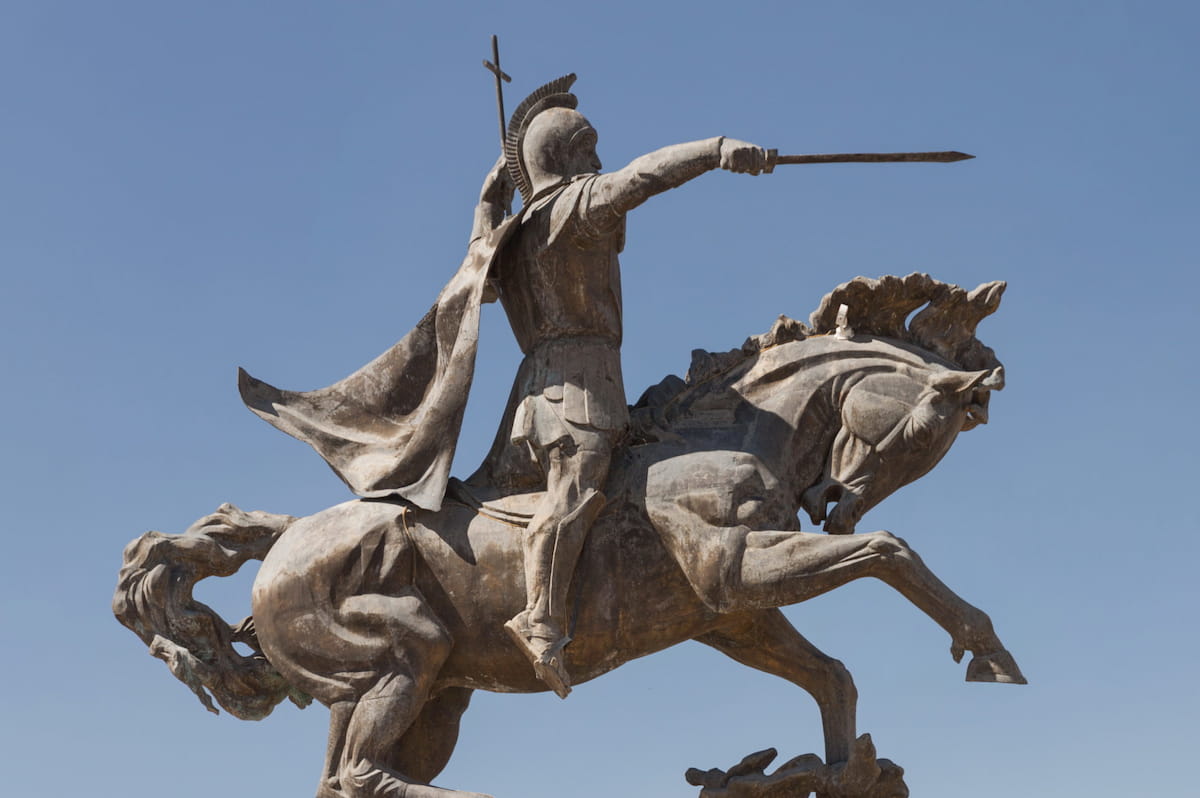
After dark, David Bek was floodlit in the centre of the town, on a rearing horse with a round shield. He was the commander whom Mkhitar Sparapet served. From 1722 he led the struggle in Syunik together with the local meliks, first against Safavid Iran and then against the Ottoman armies, and in 1727 at Halidzor he defeated a larger Ottoman army. He died in 1728. The statue, in hammered copper, is the work of the sculptors Sargis Baghdasaryan and Marat Nurijanyan, with the architect Varuzhan Sahakyan. Sargis Baghdasaryan, who was born in Artsakh in 1923, is also the sculptor of We Are Our Mountains.

What I understood
Elmira, a woman in the street, a man on a staircase, Spartak and a dog made this day between them, and none of what they gave me had been arranged in advance. The only plan I had was the mountain, and it is the one thing that did not happen. In front of the monument to Gusan Ashot I had said that by preserving alone we cannot go forward, and that each of us has to help with whatever we are good at. I think that is exactly what the people I met that day were doing: they took what they had, whether a hotel, a car, a language learned in Athens or a street they knew, and used it to send a stranger on his way.
I stayed at Hotel Mira, Goris, which Elmira runs with her son Spartak, who drove me to Khndzoresk and on to Kapan. Say I sent you.
In the next article, we go up Khustup at three in the morning after all.