Ijevan: The Town Nobody Talks About, and a Cabin Built by Watching YouTube
Garo Kotchounian9 min readFiled under Ի, ini, in the alphabet indexIjevan
In this article (7)
It is nine in the morning in Gyumri and I am talking to my phone in Armenian.
I am speaking to it, not typing. I tell it where I am and where I want to get to, Vanadzor first and then Ijevan, and that I do not have a car, so whatever it suggests has to work on public transport. Then I ask it what there is to see.

It answers me in Armenian. It suggests Lastiver in Tavush, the ruins of Lori Fortress, Odzun basilica, the dendropark at Stepanavan, Aghtala. When I tell it I have had my fill of monasteries, it adjusts and offers me Pushkin Pass instead. It tells me to get from Gyumri to Vanadzor first, and that near Vanadzor market I can pick up a minibus to Ijevan.
Then it says: since it is nine in the morning, I suggest you hurry to Gyumri bus station.
So I hurried to Gyumri bus station.
The bus did not exist
I got there at about half past eleven. The next bus to Vanadzor was at two o’clock.

That is the part no itinerary tells you. Not that the advice was bad. The route was exactly right, and I took it in the end. But the timetable in a language model’s head is not the timetable at the station, and standing in a bus yard in Gyumri with two and a half hours to burn is where the actual day starts.
I found a shared taxi instead: three or four passengers waiting for one more to fill the seat, 1,500 dram a head to Vanadzor, and the ride takes about an hour. This is how people here move when they do not have a car, and nobody had to explain it to me: you walk into the yard and ask.

In Vanadzor I bought a minibus ticket, ate lunch while I waited, and left for Ijevan around half past two. Another hour and a half, climbing, the valleys going greener the whole way.

Total cost of a plan that did not survive contact with a timetable: nothing. Total damage: none. I got where I was going, on the day I meant to, by asking three people in a car park.
Ijevan splits in two
I have heard about Dilijan my entire life. Everyone says Dilijan, and the route everyone describes is Yerevan, Sevan, Dilijan. That is the loop.
I had barely heard of Ijevan, and Ijevan is the capital of Tavush province, forty minutes further on.

The river is the Aghstev, and it does not so much pass through Ijevan as organise it. It comes down out of the mountains above Dilijan, runs a hundred and twenty-one kilometres north-east through both towns, crosses the border to become the Aghstafa, and ends up in the Kura on its way to the Caspian.
What that means on the ground is that the town has no single centre. The Aghstev splits it lengthways and the bridges stitch it back together. You cross one, walk a hundred metres, and there is another. In places the houses are built out over the water on stilts and balconies, hanging above the current with washing strung on the rails. The first thing I said out loud was that it looked like Amsterdam, which is a ridiculous comparison and also the only one that came to mind.


A park with a hundred sculptures in it
The town park is not a park. From 1985 into the early nineties, Ijevan hosted an international sculpture symposium: 95 sculptors from 20 countries came and worked in the central park for weeks at a time and left their work behind for the city. For a month and a half each summer the park stopped being a park and became an open-air studio: people with chisels working in the shade of the conifers while the town walked around them.
Consider what that took: a provincial town in the last Soviet years, hosting artists from twenty countries, summer after summer, straight through the end of the union that started it. And the keeping is the unusual part. The work did not go to a museum in the capital. It stayed in the park where it was cut, which is why the town still has it.

Ijevan is known as the city of a hundred sculptures, and the number is not a boast. You walk down avenues of conifers past a mother and child carved out of tuff, past a boulder someone has opened like a shell, past a hundred more.

There is an open-air swimming pool in the middle of it with children in it and mountains behind them, and as far as I could tell you just walk in.

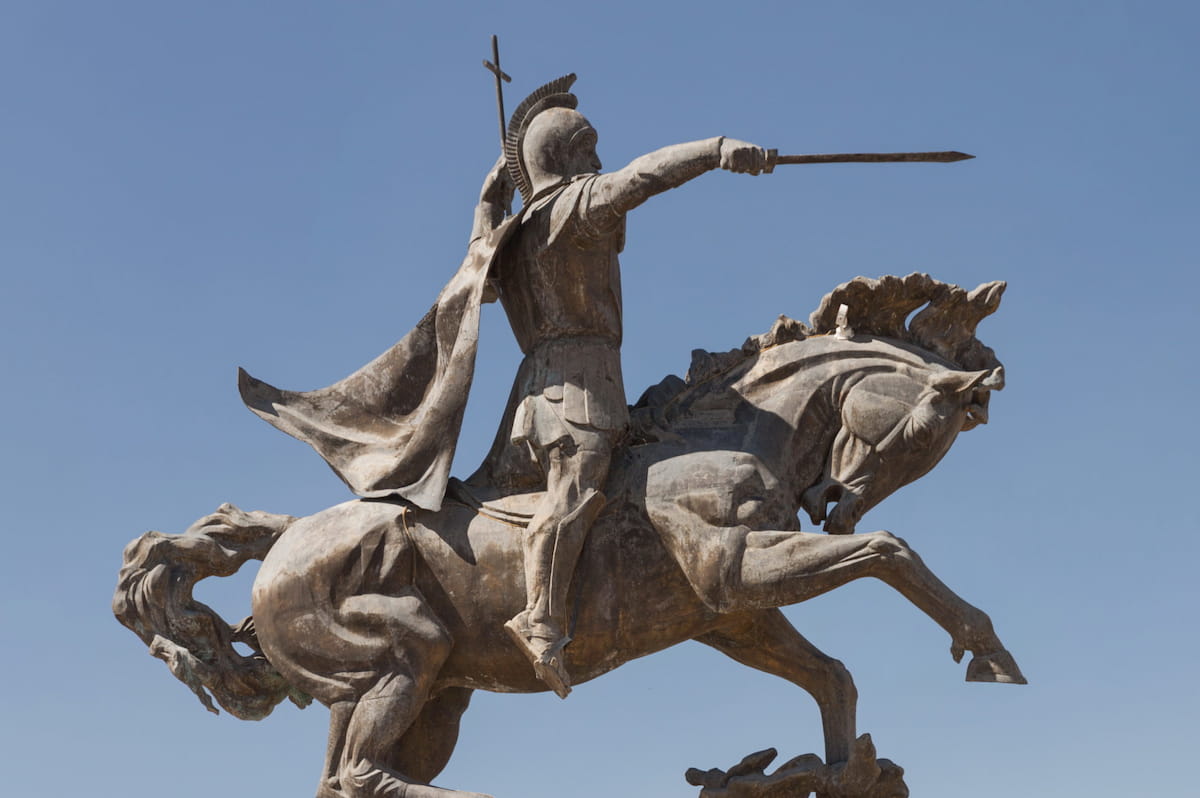
Up the hill, black against the ridge, a king rides out on a rearing horse with a sword in his right hand and a cross in his left. My driver told me his name was Ashot. My driver was right.
He is Ashot II, third king of the Bagratuni line, who ruled from 914 to 929 and is remembered as Yerkat, the Iron. He earned the name the hard way. His reign was spent putting down pretenders to his own throne and fighting off the Arab emir Yusuf, and by 922 the caliph in Baghdad had given up and recognised him as shahanshah, king of kings. He died seven years later without an heir, and his brother took the crown.
The statue is far younger than it looks: Armen Davtyan made it in 2017, six metres of it, nine with the pedestal, and it is one of very few equestrian statues of a king anywhere in Armenia. A town of a hundred sculptures put its newest one on the highest ground it had.

There is a second monument on a second hill at the northern edge of town, put up in 1971, and the figure on it is holding nothing at all. I did not know that yet. That is the next morning.
Nobody talks about this town.
Gandzakar, and a man who learned to build from YouTube
I stayed four kilometres out, in a village called Gandzakar.
I had booked it on Booking.com. When I arrived, a man called Nver came out to meet me, walked me round, and took me into his family’s house for coffee before I had even put my bag down. There was no reception desk; there was a kitchen.

On the same ground there are two stone houses and a wooden A-frame cabin, and there is a second A-frame going up beside the first. The foundations are already in the earth, waiting.
The A-frame is his. He built it himself.
“I was living in Russia. In Sochi. Everywhere there, people build places and rent them out, even garages. That is where the idea came from: go back to our village, and build a guesthouse here.”
The stone building came first, and it had not been a house at all. It had been a farm. Animals lived in it before people did. They converted it.
Then he decided to build the wooden one, in a garden where there had been nothing.

Two months. Himself and two people helping, three of them start to finish. Every material was sourced locally. The whole interior is wood: the tables, the kitchen counter, the doors. He made the doors.
Inside it sleeps four. A sofa bed downstairs that folds out for two, and a bed up a ladder in the loft for two more. It is insulated rather than air conditioned, and it holds the outside temperature, which in a timber building in an Armenian August is not what you expect.

There is a triangular window at the apex, and when you are lying up there what you see through it is the mountain.
I am afraid of heights. I climbed the ladder anyway and told him so on the way up.

I asked him what the hardest part had been.
“The very top. It is a very sharp triangle up there, and working at the top is hard, pulling it tight so the water cannot get in. I fell once. Well. I caught myself. I did not fall.”
He said it the way you would mention a bus being late.
The two names, and a mountain that was renamed
The booking said Budur, so I asked him what Budur meant.
“There is a mountain here. That mountain used to be called Budur. They have changed it now. It has become Tesilk. I do not know where Budur comes from. Maybe Persian, maybe Turkish. It is not an Armenian word. Ijevan used to border Azerbaijan, there was coming and going. Perhaps the name was taken from over there. It is not an Armenian name, and that is why they changed it.”
The mountain above the village lost its old name. The guesthouse at the bottom of it kept it.

And there are two names, because there are two kinds of building:
- Budur: the two stone houses, the converted farm.
- Old Farm Guest House (Հին Ֆերմա): the wooden A-frame, named for what stood on the ground before it.

A guesthouse named after a farm, at the foot of a mountain named after a word nobody can place, in a province that used to be a border.
What he actually wants you to know
Late that night it rained and the air went humid, and I found myself giving him advice: put a ceiling fan in the corner with a remote, you do not need air conditioning here, the air is too good for it. Put lights in the tree out front, so people can sit outside after dark. He turned the light off to show me how black it gets. He is right that nobody could sit there. He is also right that it would be beautiful with one small lamp.
That is what a guesthouse is and a hotel is not: by ten at night you are arguing about ventilation with the man who built the roof.
I asked him for a last word for the diaspora, for people who have heard of Yerevan and maybe Dilijan and nothing else.
“I would tell them to visit places in Armenia other than Yerevan. Get to know different regions. In Ijevan the people are different. They think differently, they speak differently.”
I had said almost exactly the same thing into a camera two hours earlier, alone, before I knew he thought it too.
He also leads hikes into the mountains above Gandzakar: the rivers, the caves, the ridges. There is no company and no schedule.
“Even if it is one person who wants to go, we can still go. The number of people does not matter.”
If you want to do this trip
Getting there without a car. Gyumri to Vanadzor by shared taxi, 1,500 dram a head, about an hour, and quicker than waiting for a bus. Vanadzor to Ijevan by minibus from near the station, about an hour and a half. Then a short taxi takes you out to Gandzakar. I had no car and nothing booked ahead, and none of it was a problem.
Staying at Gandzakar. Both properties are listed online under their own names: Budur for the stone houses, Old Farm for the A-frame. Booking links and contacts for each are on our Gandzakar guesthouse page. It is a small place and it books up.
The AI. Use it. Just do not believe it about departure times.
Next: back to Yerevan, and then south to Goris and Tatev.