Khustup at 3 a.m.: A Fox at 3,200 Metres, a Sea of Clouds, and the Sunrise
Garo Kotchounian12 min readKapan
In this article (10)
The day before, Harut, the guide, had come to find me to say that the weather on Khustup was no good and that we had better go another day. Yet at three in the morning I was standing in my hotel room with the camera, saying that we were going up Khustup after all. I did not know what was waiting for us; I knew only that we were meant to see the sunrise. We did see it in the end, but before it the mountain gave us several things I had not asked for, and this is the story of them.
It was Monday, the seventeenth of August, the morning after the long way round from Goris to Kapan.
Three in the morning

A yellow four-by-four was waiting outside the hotel, with Harut at the wheel. He asked me where I was from, and when I told him, he said that this time he wanted to go to Egypt, and another time to Cyprus, for the sea, because the sea heals. I told him that September is the month to come, when there are not many people. Soon we were in the forest, with the headlights on the wet leaves, and we had just passed the village of Tsav on our way up for the sunrise.

Further on, the track crosses a stream, and the car went through it the way a horse goes through a puddle. When I asked whether the people left in the villages up here were mostly the old, Harut said that they were. Somewhere in the dark he stopped at a house to fetch a jacket for me, which was lucky, because I had not brought one. He came back with a few more as well, just in case. Then the trees ended, and the road began to climb.
By headlamp to 3,100 metres
The cars stop at about 3,080 metres, and the rest of the way is on foot, in the dark. My camera does not cope well with darkness, so the film shows only what it managed to catch: a lamp on a rock, a figure climbing, my own breath. At one point I said “adrenaline”, and I stand by the word. For all the warnings, the weather was good, with mist and dew, and I said so to the camera. At 3,100 metres a voice ahead of me called, “Garo jan, come,” and when I caught up, Harut turned to the camera and introduced himself to you: “I’m Harut. I’m your guide, Garo jan.” We were climbing to the peak of Mount Khustup, some 3,200 metres high.

After that I told the camera that I would switch it off until I was up, so that there would be no accident.
The summit in cloud, and a fox
My phone recorded 3,200 metres at 05:52. About a dozen of us were on the rocks in thick cloud, and someone shouted down into it. We waited, and at one point I told the camera to look, because the sky had opened.

Then, in the middle of a sentence, I saw a fox. It was a real one, and it walked up the grass towards the group as if it had an appointment with us. The other climbers spoke to it in Russian, the way you would speak to a cat, and it let them. Harut told me later that the foxes are always there and that they come to eat bread with the climbers; the mountain is so calm, he said, and nobody shoots, so the animals have grown used to people. I have been to a great many places, but a fox has never before come to breakfast with me at 3,200 metres.

Above the clouds
The cloud around us cleared, and the rest of it lay beneath us like a sea, pink at the edges from a sun we could not yet see, with only the peaks of the other mountains standing out of it like islands. “We’re higher than the clouds, can you imagine?” I said, and then I said it again, because I could not imagine it myself. I had never seen such a thing with my own eyes, let alone so close. Red-billed choughs sat on the rocks as if they owned the place, which they do.

I set the camera to record a timelapse for twelve minutes while the cloud poured between the pinnacles, and in the film those twelve minutes pass in five seconds. When the sun came up over the sea of cloud, I was pointing the camera the other way, but someone I met that day caught it on a phone and sent it to me afterwards. So we had our sunrise after all, a little later than the timetable promised, and from above the weather instead of beneath it. I had also missed the mountain’s own shadow, laid on the cloud like a pyramid with a faint ring of light at its tip, and that too reached me later in a photograph.


We walked down into the light. By seven o’clock the sun was over the ridge, the group was strung out along the path with the sea of cloud behind it, and the cars were tiny dots on the plateau where we had left them.

Nzhdeh’s bust, and the flag
Where the cars stop, on the open plateau some 120 metres below the summit, there is a flagpole, a round white plaque and a bronze bust on a stone pedestal inside a chain fence. The bust is of Garegin Nzhdeh, the commander who defended Syunik from 1919 to 1921, and its pedestal carries a quotation signed with his name. The plaque reads “Syunik is the backbone of Armenia”, a saying associated with him. On camera I said that the place has another story, if you know it; here I will give only the facts. Nzhdeh had asked to be buried on Khustup, within sight of Kapan. In 1983 part of his remains was buried in secret by the Kozni spring, on the mountain’s slope, and on 26 April 2005 more of them were reburied at his memorial in Kapan, at the foot of Khustup. The bust up here is a monument to him, not his grave.


The tricolour was flying above my head, and I pointed the camera up so that you could see it, which you can. “Our flag waves everywhere,” I said. “May our tricolour wave everywhere, dear ones.” That was the high point of the day for me, and it was not at the top of the mountain.

Harut
Back at the yellow car, I asked Harut to tell you about the place. Khustup, he said, is called the prayer mountain, from khut, a root that means prayer, and it is a place of pilgrimage. After Aragats, he said, it is the most beautiful and the most mysterious of all the mountains in Armenia, and people come with a vow of their own, climb, and find the vow fulfilled.

He has been doing this for ten years and calls it the work he loves. He goes up about twice a day, once for the sunrise and once for the sunset. His guests come from Yerevan as well as from Kapan, and most of them join his tours in Kapan. They are mostly Armenians, among them people from the diaspora who come to Armenia and climb the mountain if they have heard of it. He has seen a bear up there, and bezoar goats, which come to lick the salt off the rocks. I had not seen the goats myself, but someone I met that day had, and sent me a picture of them on the grass below the summit ridge. His red car takes ten people and the yellow one seven. I told him I would put his details on our website, and here they are: Khustup Hiking and Jeeping Tour, on Instagram as @khustup_hiking_jeeping_tour.


Coffee and honey
On the way down, Harut invited us to his house, in a village on a green slope below the mountain. There was coffee and tea, and honey of their own: the family keeps hives and does not sell what the bees make, because it is for the house. Flowers grew everywhere. In the garden an older woman was picking greens, and I caught myself not knowing what any of them were. “We are the supermarket generation,” I said to the camera, and I thought how good it would be to hold on to a place like this.


On the drive back we passed a donkey on the road and a waterfall in a gorge, and saw Kapan from above. Then I went to bed, having been up since before three.
Kapan with Aram
In the evening a man I call Mr Aram, because that is what I called him on camera, drove me into town under the flags at the entrance and then out the other side. On the way in I asked him the things one asks. The population, he said, had once been sixty-odd thousand, and now, with so many gone abroad, it was perhaps fifty-five thousand, counting the villages. He likes his city very much, for its climate and its nature. The mayor, he said, has made it beautiful, and quickly, with new trees, restaurants and parks, first in the centre and now on the outskirts; he has given Kapan a proper look. The park in front of the city hall, with its new benches, had opened fifteen or twenty days before, and I would walk through it that night.
The first stop out of town was Vahanavank, a few kilometres west of Kapan. Its first church was completed in 911 by Prince Vahan, a son of Dzagik, who ruled Baghk, the district of Syunik in which Kapan lies. The monastery became the burial place of the kings and princes of Syunik. Aram lit candles inside. Outside, what is left of the arcade stands roofless, with one of its arches still open to the sky. Restoration began in 1978 and broke off unfinished in 1990; a second campaign, from 2006 to 2009, restored the main church and its gavit, but the arcade is still only partly restored.

About two kilometres to the east, back towards Kapan, on a hill above the town and the valley of the Voghji, stands Halidzor fortress. It was built in the seventeenth century as a convent, and it later became the headquarters of David Bek and of Mkhitar Sparapet. At the end of February 1727 an Ottoman army laid siege to it. The defenders held out for about a week and then charged out in a surprise counterattack, at which the Ottomans lifted the siege and fled. Today you can walk through a vaulted stone passage in its walls. The histories also record a secret tunnel, about 500 metres long, that ran down to the Voghji to keep the fortress supplied with water during a siege; it is now covered over and partly in ruin. Aram told me the local story of another passage, through which, he said, people went in at Vahanavank, came through here and went out. That one, he said, has collapsed and is closed off. The hope now, he added, is to restore the fortress: to dig, to find what is left and to rebuild it.

From the top, the whole of Kapan lies below you. I asked where the water goes. “From up here, from Kapan, down to the Araks,” Aram said. “It reaches the Araks and mixes into it.” The river is the Voghji, and it is indeed a tributary of the Araks.

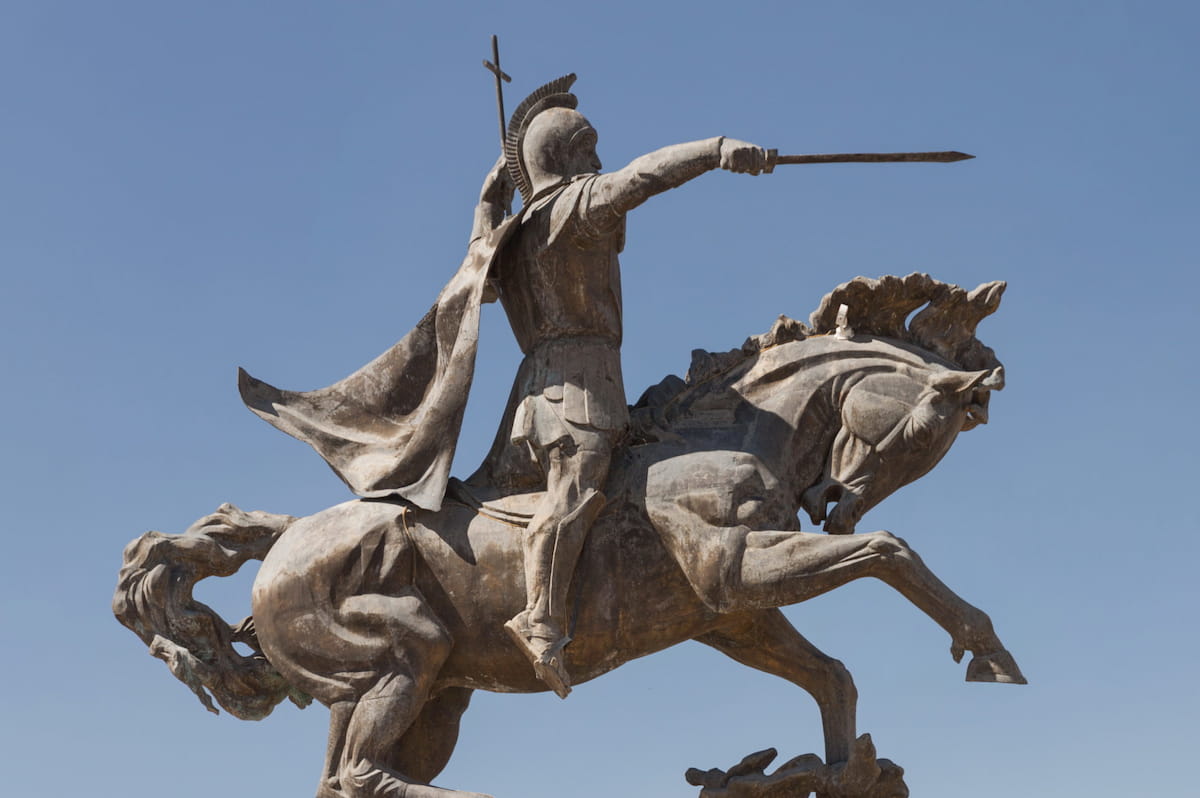
Back in the centre at dusk, David Bek sat on his horse above the street, beside a long wall carved with soldiers, and the river ran on below. I wrote about his statue, which I saw on the evening I arrived, in the previous article.

Kapan at night
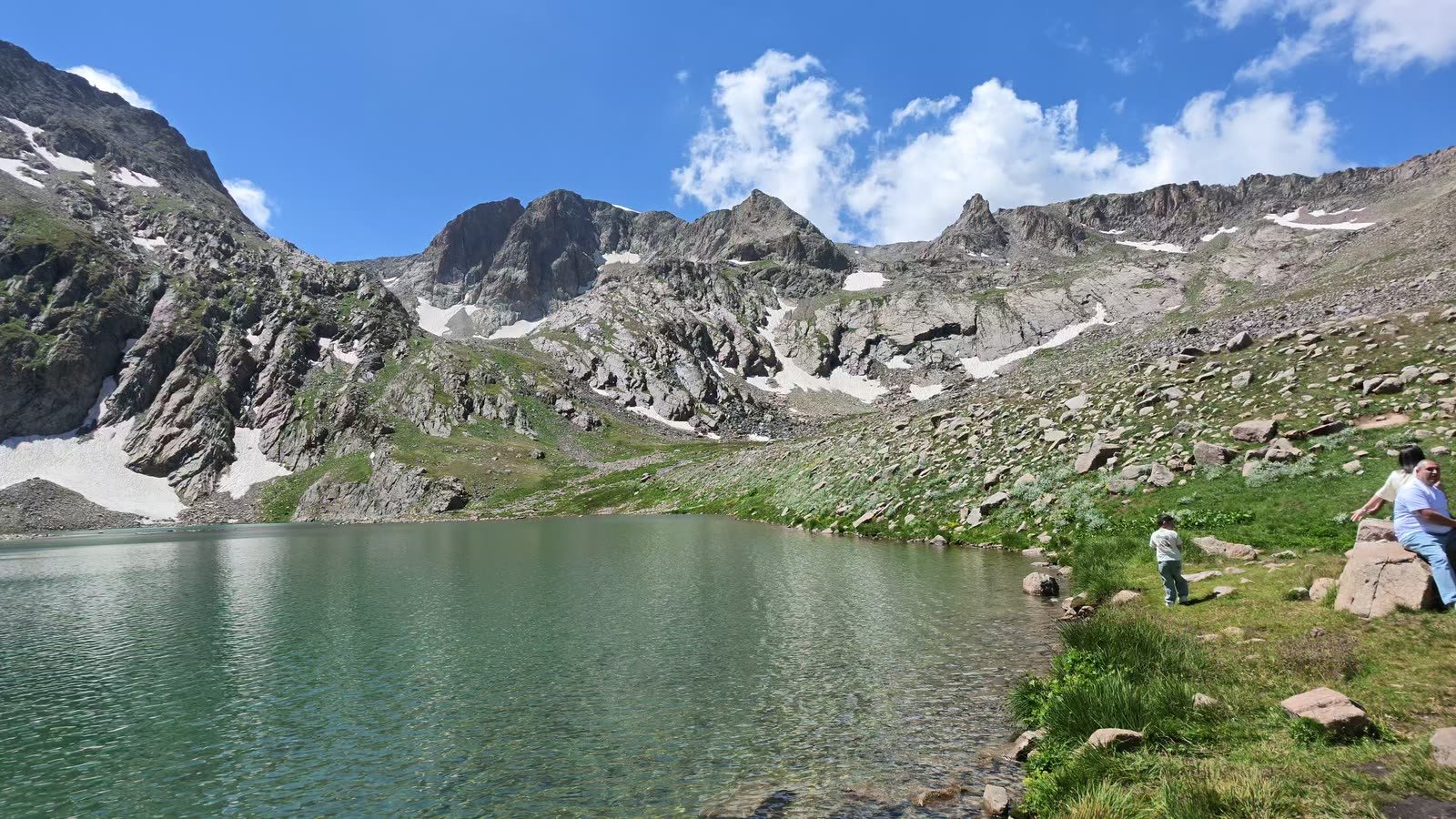
After dark I walked along the river, talking to it. I wanted to get across to the other bank and thought there was a bridge somewhere. I told the river that if you hold on to a river you cannot get lost, because it takes you up to the top and brings you back down again, and this one did. I had one more night in Kapan, and I told the camera the plan: the next day we would go to the lake, towards the Nakhichevan side, where there should be snow even in August; then a taxi to Meghri and back; then Yerevan on Wednesday, and Gyumri after that. What actually happened the following day is the subject of the next film.
The park in front of the city hall, the one Aram had told me about, had new benches and new everything else. There were families on the benches and children everywhere, and the fountains were lit purple and blue. Later, in the dark under the trees, I came to a bronze statue of a soldier in a long coat, and I read the name on the pedestal: Hunan Avetisyan. He was born in Tsav, the village we had passed in the dark that morning on the way up the mountain. He was killed near Novorossiysk in September 1943, when he covered the embrasure of a German machine gun with his body, and he was made a Hero of the Soviet Union after his death. His statue, unveiled in 1959, is by Sargis Baghdasaryan, one of the two sculptors of the David Bek monument.
Then came the funfair, with its castle towers, and a stall making what we Lebanese call ghazil banet and English speakers call candyfloss or cotton candy. If you know the Armenian word, write it to me and I will learn it. Without meaning to, I ended up at the church square where I had stood the evening before in daylight; now it was night, the square was full of people, and the water was lit.


What I understood
You go up a mountain for one thing, and the mountain gives you another. I went for a sunrise and was given a fox, a sea of cloud, our flag flying on the plateau, a man who told me why Khustup is called the prayer mountain, and honey that his family keeps for the house and does not sell. The sunrise, when it came, rose out of that same sea of cloud. At the end of the day there was a town that had given itself new benches and was sitting on them. On my first evening in Kapan, by the river, I had said that I loved this trip, and I still do.
My guide was Harut, of Khustup Hiking and Jeeping Tour in Kapan, who goes up about twice a day, for the sunrise and for the sunset. He is on Instagram as @khustup_hiking_jeeping_tour. Ask him about the foxes.
The sunrise video and three of the photographs (the mountain’s shadow, the goats and the table at Harut’s house) were shared with me by people I met that day. Thank you.
In the next article, Harut drives us up to a lake the following morning, and then I go on to Meghri.