The Third Mother Armenia: Ijevan’s Statue, and the 250 Trees Below It
Garo Kotchounian5 min readFiled under Մ, men, in the alphabet indexIjevan
In this article (7)
There are two Mother Armenias I knew about.
There is the one in Yerevan, above the city in Victory Park, holding a sword across her hands, and there is the one in Gyumri. I had stood in front of both. So when somebody says Mother Armenia, those are the two that come to mind, and I assumed that was the whole list.
It is not.
The morning
I woke at seven in a village called Gandzakar, four kilometres outside Ijevan, in a guesthouse a man built himself after watching YouTube. There were roses at the window and roosters somewhere down the road, and the wooden A-frame he made with two friends in two months sat in the garden behind me.

There were plums on a tree by the gate, hanging heavy and dark. I checked whether they were ripe. They were ripe. I washed one and ate it on the roadside and I would like it on record that I asked nobody’s permission.

Then I got in a taxi.
The road up
The road out of Gandzakar runs down into the valley and then climbs the other side. Ijevan opens up below on the left: tin roofs, poplars, a river somewhere in the middle of it. There is a great slab of rock standing over the road on the way in, a proper cliff, with a petrol station tucked beneath it as if nobody had noticed the scale of the thing.
And then, at the northern edge of town, a staircase.
You see the steps before you see what is at the top of them. Wide, grey, Soviet, climbing a green hill in a straight line. That is the correct order to meet her in.
Mother Armenia, Ijevan
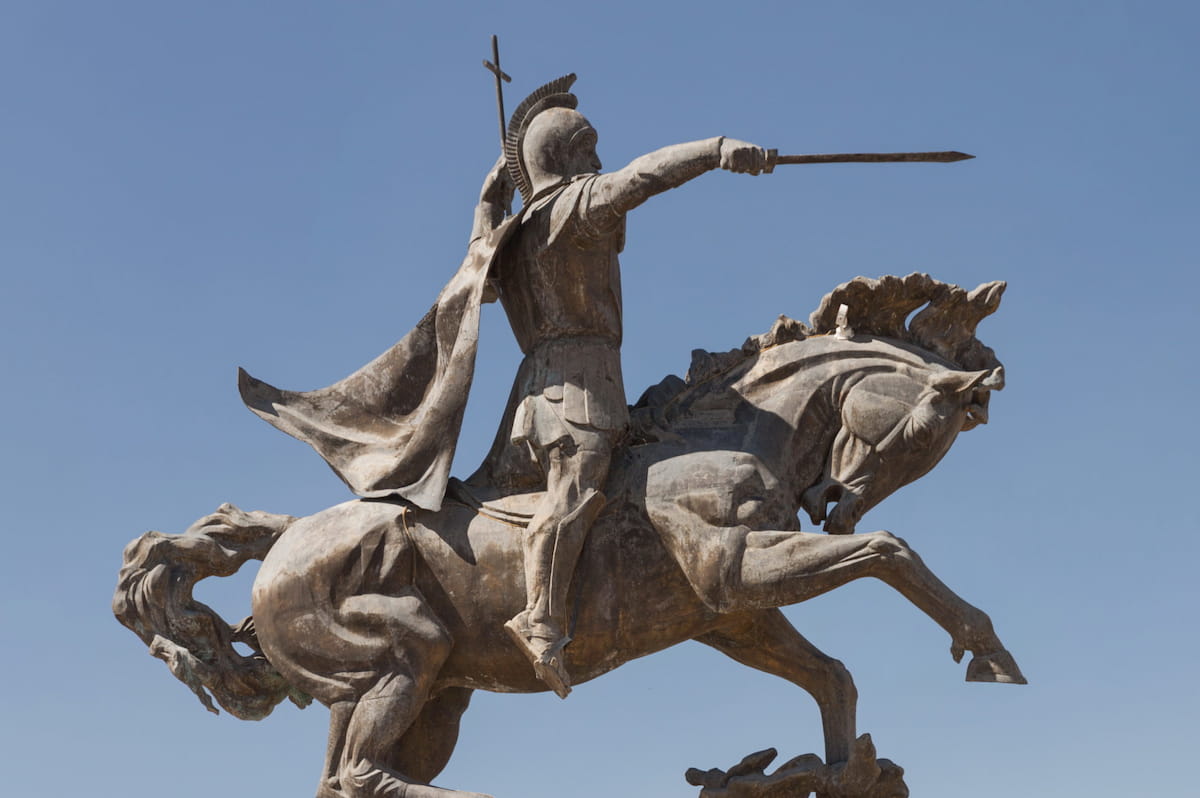
She stands with both arms thrown open.

That is the thing that stops you, if you know the other two. The Yerevan statue is a warrior, a sword laid flat across her hands, watching the city. This one is not holding anything. Her arms are out, wide, palms open, facing the valley. She is not guarding. She is receiving.
She was erected in 1971 to a design by Serzh Mehrabyan, raised to mark the victory in the Second World War, and in the years since the site has taken on the heroes lost in the wars that came after it. That is less a repurposing than an accumulation: the same hill, asked to hold more each time.
She stands about three kilometres north of the town centre, on the hill above the Ijevan–Tbilisi road, and she is listed among Ijevan’s immovable cultural heritage. Behind her the Tavush mountains go back in layers until they turn into weather.


I stood there and said out loud, to the camera, that I had not known she existed. I had seen Yerevan. I had seen Gyumri. I assumed that was all of them.
And then I looked down the hill
Below the monument, running away from the steps in two long lines, there are young conifers.

This is not landscaping. These are rows, each one the same distance from the next, each one with a small plaque set in the grass in front of it, the whole avenue running down the slope in a straight, deliberate line like a formation.
There was a man working among them. I asked him what they were.
“It looks as though the trees were planted in memory of people, doesn’t it? Who were they? Ordinary people, or heroes?”
“Heroes. Heroes. Two hundred and fifty people. Two hundred and fifty from Ijevan, people who fought in the wars.”

So there are two hundred and fifty trees, one for each of them.
He said wars, plural, and he was being exact. The monument above him went up for one war. The ground below it has been given over to the men lost in the ones that came after.
Then I asked him whether he was the one who looked after the place.
“Yes.”
“And your pay?”
“I do it myself.”

He is not employed to do it. He does it.
Two kinds of remembering, fifty years apart
This is what I keep coming back to.
At the top of the hill is what a country builds. A state commissioned it, a named sculptor made it, 1971, official, on the heritage register, visible from the whole valley. It will outlive everyone reading this.
At the bottom of the hill is what people do. No architect. No unveiling I could find any record of. Two hundred and fifty saplings and a man with a hose who gets nothing for it.
They are separated by half a century and about a hundred metres of grass, and they are not the same act. One is a country saying we won. The other is a town saying these were ours.

I have thought about that a lot since.
What I actually said, standing there
I said it into a camera on an empty hillside in Tavush with nobody around except a man watering trees, and I meant it more than I usually mean things I say into a camera.

If you go
Mother Armenia, Ijevan sits on a hill at the northern approach to the town, on the main road, about a five-minute drive from the centre. There is no ticket, no gate and, when I was there on a Friday morning in August, nobody else at all.
Go up the steps rather than round them. Then, before you leave, walk down the hill to the trees and read a plaque.
Most people in the diaspora have heard of Dilijan. Ijevan is forty minutes further on, it has a river running through the middle of it, more than a hundred sculptures in the town park, and a third Mother Armenia that nobody seems to mention.
Next: back to Yerevan, with nowhere booked to sleep.