Armenian Cultural Gala in Nicosia: The Komitas Project, Khali the Carpet Dance, and 35 Years of Independence
Garo Kotchounian11 min readFiled under Ն, nou, in the alphabet index
In this article (7)
Armenia’s Independence Day falls on 21 September. On that date in 1991 the people of Armenia were asked in a referendum whether they wanted an independent democratic state outside the Soviet Union, and 99.51 per cent of those who voted said yes, on a turnout of 95 per cent. Thirty-five years later, three days after the anniversary, the Armenians of Cyprus marked it in the way they like best: in a theatre, with singers and dancers from Yerevan, and with sweets at the door beforehand.
Armenians have lived on this island since at least the sixth century, and on the evening of 24 September they filled the Strovolos Municipal Theatre in Nicosia for the Armenian Cultural Gala. I took the camera. What follows is what I saw, and whom I met when the lights came up.
The welcome
The evening began at half past six outside the theatre, with traditional sweets and drinks and a photo corner under the trees, and by the time the curtain rose the hall was full. The gala was organised with the support of the Embassy of the Republic of Armenia in Cyprus, and the embassy’s staff came in person. Ambassador Inna Torgomyan, who became Armenia’s first resident ambassador to Cyprus in 2025, was there with her team, among them the consul, Anush Harutyunyan. So were Vartkes Mahdessian, who has represented the Armenians of Cyprus in the House of Representatives since 2006, and his wife Maggie. The embassy’s photographs of the evening appear in the film with their credit; my footage of the performance begins as the curtain rises.
The Komitas Project
The first half belonged to the Komitas Project of the State Song Theatre of Armenia. Singers in black stood among the microphone stands, a pianist sat at a grand piano beside them, and on the screen behind them the images moved through clouds, stars, the face of Komitas and a page of handwritten music.

Komitas Vardapet was born Soghomon Soghomonian in Kütahya, in the Ottoman Empire, on 26 September 1869 by the Julian calendar then in use, which is 8 October by today’s. Armenia marks his birthday on 26 September, so the gala fell two days before it. He is regarded as the founder of the Armenian national school of music and as one of the pioneers of ethnomusicology. He collected and transcribed more than three thousand pieces of Armenian folk music; more than half of them were later lost, and about twelve hundred survive. On 24 April 1915 he was arrested and deported to Çankırı with other Armenian intellectuals. He was released after others intervened on his behalf, but the ordeal left him deeply traumatised, and he spent his last years in psychiatric hospitals in Paris without composing again. He died at Villejuif, near Paris, in 1935, and in 1936 his remains were taken to Yerevan and buried in the pantheon that now bears his name. Without the songs he saved, these singers would have had far less to sing in Strovolos more than a century later.
The company that sang them is much younger. The State Song Theatre of Armenia was established on 1 April 1994, when the State Jazz Orchestra of Armenia was reorganised, and its founder and artistic director was the composer Artur Grigoryan (1958 to 2022), a People’s Artist of Armenia who wrote songs and children’s musicals, and the teacher whom Karina, our guide on the road to Tatev, remembered as Arthur Grigorich. The gala credited the Komitas Project to Grigoryan as its creator and to Hrach Keshishyan as its director. Keshishyan, born in Yerevan in 1970, is a film director, screenwriter and producer whose films include The Deer Season (2017) and The Mechanics of Happiness (2021), and who produced The Voice of Armenia for television; his own biography lists Komitas by Arthur Grigoryan among his theatre productions of 2024.
Most of what the singers sang was Komitas, renewed in a very modern way, and some of the songs were sung by the voices alone. Grigoryan had done this before. In 2011 his State Song Theatre staged his musical Komitas: Ekel em (I Have Come), built on twenty Komitas songs, with Grigoryan himself at the piano. Among his other projects was Voices of Artsakh, an ensemble of young singers from Artsakh.

I kept one moment in the film for longer than any other. My camera had been on the piano, and when I turned back, two of the singers were sitting on the very edge of the stage with their feet over the front row, two more just behind them, and they were singing from there, straight to the people in the front seats. I did not want to cut away, so I did not. You can hear it in the film above, from 0:46.


The film between the halves
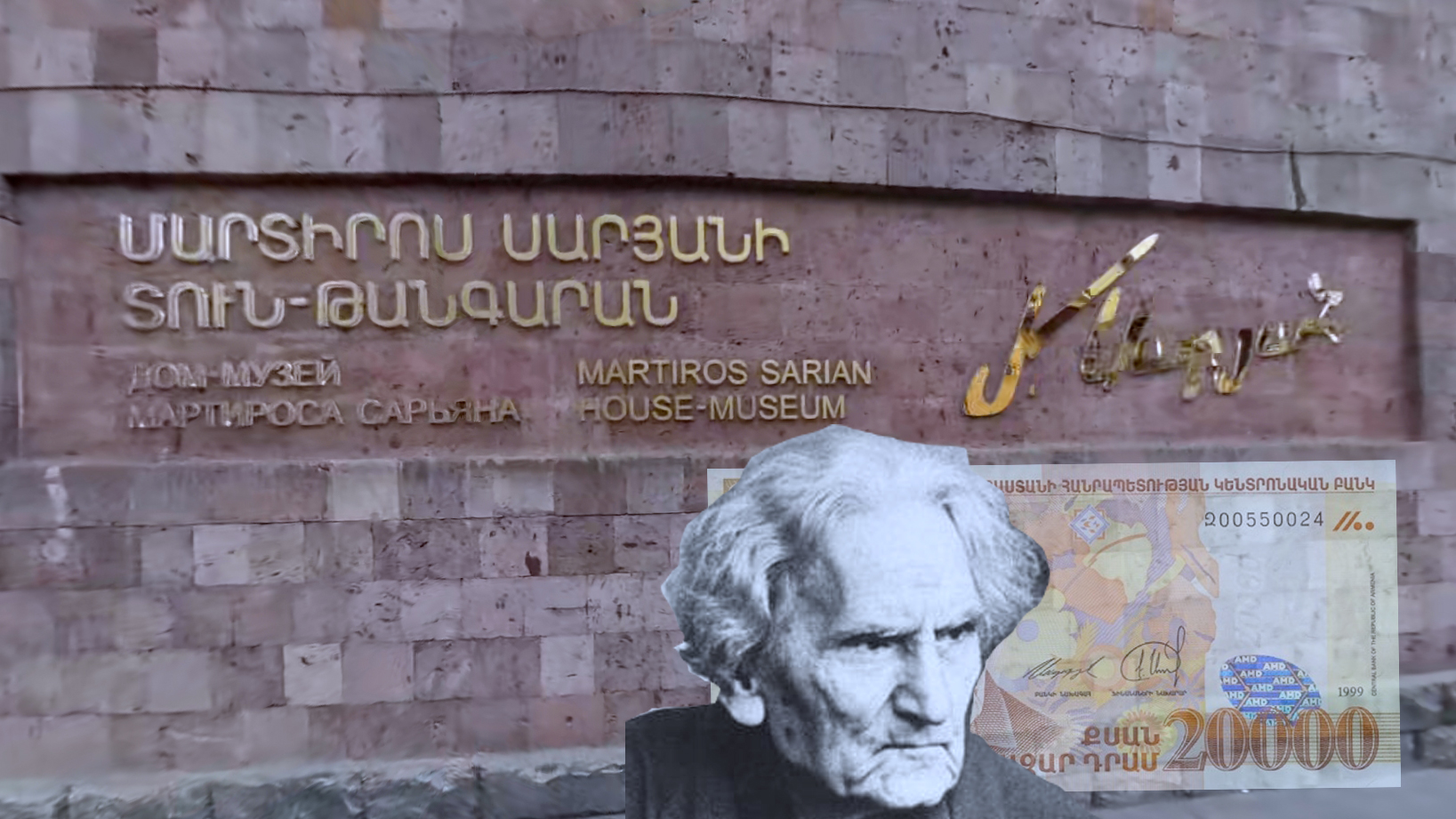
After the singers took their bows, the lights went down again and a film of more than eight minutes, narrated in English, was projected on the screen above the piano. It told how the Armenians, scattered across the world after the trials of the twentieth century, kept their language and their culture wherever they lived, in Yerevan, Paris, Moscow, Beirut, Los Angeles, Buenos Aires and Nicosia. Then it named some of the people who carried something Armenian into the wider world. The older generation came first: the composers Aram Khachaturian and Arno Babajanian, the film director Sergei Parajanov, the painters Martiros Sarian and Arshile Gorky, the singer Charles Aznavour, the chess champion Tigran Petrosian, the choreographer Vanush Khanamiryan, and the actors Vahram Papazian, Mher Mkrtchyan and Sos Sargsyan. After a passage on 21 September 1991 and the hard years that followed independence came the people of today. Among them were Cher, Serj Tankian of System of a Down, the pianist Tigran Hamasyan and the singer Brunette; Karren Karagulian and Vache Tovmasyan, of Anora, which won the Oscar for Best Picture in 2025; the actor Simon Abkarian, the chess grandmaster Levon Aronian and the footballer Henrikh Mkhitaryan. The singer Sona Rubenyan was there too, without a caption, in a scene from her video Vardavary Galis E.
I read the pairing of Cher and Brunette as the older generation handing over to the new one, and of the new generation the name I would watch is Sona Rubenyan. In 2017 she and Garik Papoyan formed the band Garik & Sona, which we wrote about in our piece on rock music in Armenia, and their work sets traditional Armenian songs beside songs the whole world knows in English: in “Wake up Harsner” they bring Chop Suey!, by Serj Tankian’s System of a Down, into an Armenian song. Their remakes of Komitas’s Aysor Ourbat e and of Ambi Dagits, from Armen Tigranian’s opera Anush, are wonderful, and there are many more. It is music that the grandparents and the grandchildren in a hall like the one in Strovolos can both recognise, and that is exactly what an evening like this one needs.
One of the names on the screen was in the hall: Arsen Grigoryan, a different man from Artur, whom the film credited with projects such as a children’s musical and with helping to build a new musical theatre scene in Armenia. In its closing minute the film turned to mime, from the great clown Leonid Yengibarov to the Yerevan State Pantomime Theatre, whose art the narrator called “a language that needs no translation”. Then the film promised that the story of modern Armenia would continue on the stage without a single word, and the voice said: “Please welcome.”
Khali, the carpet
The second half was a dance, and not the dance one expects at an Armenian evening. Khali is a contemporary piece with idea and choreography by Rima Pipoyan, music by Hayk Karoyi and the Khazer Choir, and costumes by Qnqush Malkhasyan, and it was produced in 2024 by the Yerevan State Pantomime Theatre. Five young women, each in a dress of a single plain colour, moved barefoot around three long wooden benches, under light that turned red, purple, grey and blue. Near the end the five of them stood in a line, hand in hand, under plain light, and the title made sense: five colours, side by side, like the threads of one carpet. Anyone who did not know that it told the life of a carpet, and how a carpet is made, would have found it a surprise.

Khali is the everyday word for a carpet in Armenian, beside the literary gorg, and the thirteenth-century Arab geographer Yaqut traced the word itself to Qaliqala, the Arabic name for the Armenian city of Karin, today’s Erzurum. The gala’s programme said that the five dancers stand for the five primary colours of the traditional Armenian carpet, and Pipoyan has named them as red, white, blue, green and yellow. She prepared the piece by studying the history of carpet weaving in archives and in interviews with weavers, and the choreography draws on the gestures of the weaver’s hands and on the motifs of the carpets themselves; she has described the body as another form of weaving.
Behind those colours stand makers of an older kind: the dyers, who drew them from plants and from one small insect. In Armenian rugs the reds came from the roots of dyer’s madder and from vordan karmir, whose name means worm’s red. This crimson dye was made from the Armenian cochineal, a small insect native to the Ararat plain and the valley of the Aras. Medieval Armenian carpets were so well known for the shades of vordan karmir that in the Arab period they were also called red rugs. The greens came from nut peels, the blue mostly from indigo brought from India, and the yellows from wild plants.

The music is by Hayk Karoyi, a composer born in Yerevan who plays the flute and the Armenian woodwinds, among them the duduk, the zurna and the blul. He studied at the Yerevan State Conservatory, founded the ethno-jazz-rock band Room 118 in 2011, and now sets ancient timbres inside electronic music. The Khazer Choir’s parts in the score are built on Armenian lullabies. Nicosia was not the piece’s first stop abroad: in June 2026 it was danced at the Black Box International Festival in Plovdiv, and it has also been presented in France, in a programme at the Maison de la Poésie in Paris.

At the bow the singers came back out and stood in a line with the dancers, and the hall clapped for a long time.

After the show
When the lights came up, the dancers were still on the stage beside the benches, in their colours, taking photographs of one another. I went up, congratulated them, and asked whether I could film a few words with them. When I offered them English or Armenian, Rima Pipoyan, the choreographer, chose Armenian, so what follows comes from the film’s English subtitles.
“We are quite a young group; you could say they are my former students. The first generation, you could say, of modern dancers in Armenia: contemporary dance, yes, contemporary dancers, you could put it that way.”
“The piece was created in July 2024,” she told me, and she named the dancers as Natella, Milena, Greta, Milena and Toma, so two of the five share a name. “Former students” is a teacher’s phrase, and she is a teacher: she has taught at the Yerevan State Choreographic College since 2008 and has headed its Modern Dance Department since 2020. She founded the Choreography Development Foundation in 2017, she leads her own company, the Rima Pipoyan Dance Company, and she is described as one of the pioneers of modern ballet and contemporary dance in her country. Her dance film YEL (2020) has won five best dance film prizes, according to her company, and her work has taken her to residencies at the Akademie der Künste in Berlin, the Venice Biennale and the Villa Empain in Brussels.
The company is on Instagram and Facebook, and its website is rimapipoyan.dance. At the end of the interview I asked her the question I ask everyone: “May I, then, put this on YouTube?” Her answer is in the film: “Yes, yes, yes.”

What I understood
Thirty-five years after the referendum, one evening in Nicosia held both ends of the same thread. In the first half, songs that Komitas collected more than a century ago were sung from the edge of a stage, an arm’s length from the front row. In the second, a dance made in 2024 took the colours of the Armenian carpet and gave them to five young women whom their teacher calls, with a modest “you could say”, the first generation of contemporary dancers in Armenia. Both halves were about things made by hand and kept: a song written down before it could be forgotten, and a colour drawn from a root or an insect and woven into a carpet. That is what I brought home from a seat in Strovolos.
The film above runs to about four minutes and holds what this page cannot, which is the sound: my introduction, the singers, the dance and the whole interview at the end, with English subtitles. More of our films are on the Aypoupen YouTube channel.
The evening, in short
| What | The 35th Anniversary of the Republic of Armenia Cultural Gala, known for short as the Armenian Cultural Gala. |
|---|---|
| Where | Strovolos Municipal Theatre, 100 Strovolos Avenue, Nicosia, at the Klimataria traffic lights. The theatre opened in 2003. |
| When | Thursday 24 September 2026, with the welcome at 18:30 and the concert at 19:00. Independence Day itself falls on 21 September. |
| The Komitas Project | State Song Theatre of Armenia, founded in 1994 by Artur Grigoryan. The gala credits the project to Grigoryan as creator and to Hrach Keshishyan as director. |
| Khali | Idea and choreography by Rima Pipoyan, music by Hayk Karoyi and the Khazer Choir, costumes by Qnqush Malkhasyan. Produced in 2024 by the Yerevan State Pantomime Theatre and danced by the Rima Pipoyan Dance Company. |
| The dancers | As the company credits them: Natela Baghramyan, Milena Barseghyan, Milena Ghazaryan, Greta Alaverdyan and Tamara Ghevondyan. |
| Support | The Embassy of the Republic of Armenia in Cyprus and the VF Foundation. |
| Whom to follow | The Rima Pipoyan Dance Company (Instagram @rima.pipoyan_dance), the Embassy of Armenia in Cyprus and the gala itself. |
| The film | About four minutes, with English subtitles, at the top of this page. More films are on the Aypoupen channel. |
My thanks go to the singers and the pianist of the Komitas Project of the State Song Theatre of Armenia; to Rima Pipoyan and the five dancers for the interview; and to the Embassy of Armenia in Cyprus for the five photographs of the evening used in the film.